Sir Francis Bacon

Histories make men wise; poets, witty; the mathematics, subtle; natural philosophy, deep; moral, grave; logic and rhetoric, able to contend.

--Of Studies--
Showing posts with label Death and Dying. Show all posts

Necrology 2

~ 700 words

New Interesting Words!

salutary - adj - favourable to or promoting health.

solecism - n - a breach, error, impropriety or inconsistency, esp. in grammar or etiquette.

inimical - adj - unfriendly, hostile, adverse in tendency, harmful.
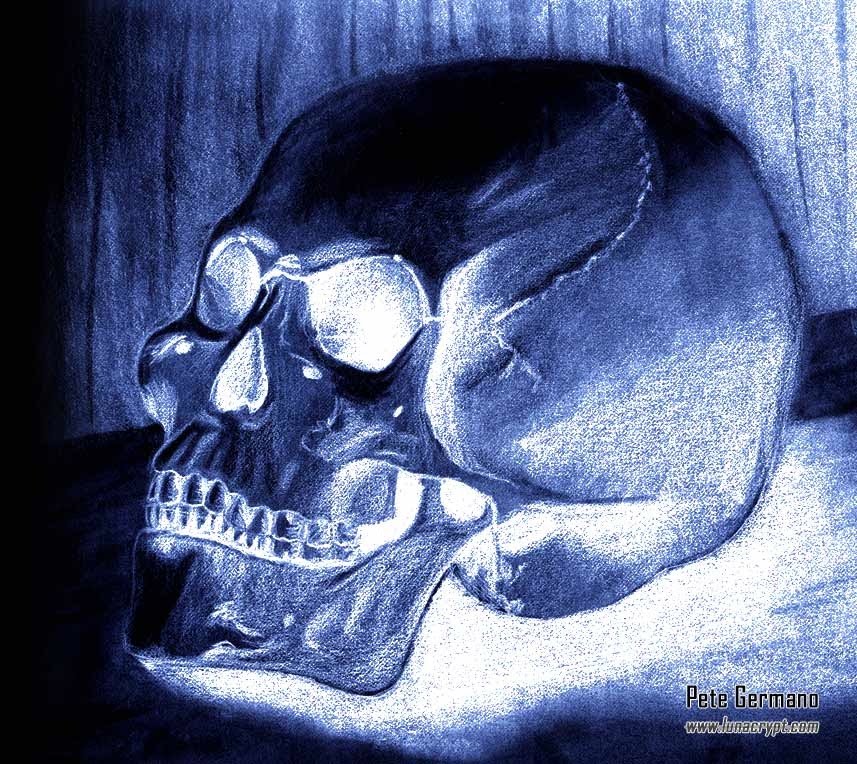

This post, as one might gather from its title, is the second in my Necrology series, based on a series of essays contained in "Death and Dying: Challenge and Change", edited by R. Fulton, E. Markusen, G. Owen, and J. L. Scheiber. Today's blog post is based on the essay "Life and Death in the USA" by Melvin Maddocks.

Let me preface by saying that I am not American in the traditional sense. That is to say, I'm Canadian. Thus, some of the more regional themes were not readily apparent to me as I read this essay, but thankfully the majority of the article is not of regional interest.

Maddocks' purpose for this article is mainly taxonomic, as he is almost exclusively interested in segregating people into groups based on their views and beliefs about death. While such systems beg for exceptions, it is interesting to note the author's perception of general trends in society. This article was originally published in 1974, so one might argue that the 70s were an entirely different time and place. I would stipulate that the 70s were the last social revolution I'm personally privy to, and much of what was decided forty years ago is still relevant in today's society (not only because people who lived through the seventies now run things. Scary thought?). We still make references to hippies, though they have long been extinct, or at least, the only surviving specimens are kept in captivity.

He groups people into three categories.

1) The Pragmatist.
These are people who act to thwart death wherever it occurs. Immortality is possible if you try hard enough, or at least, death can be managed out of existence. Hence you get a plethora of how-to books, guides, handbooks, pamphlets etc. all espousing their particular theory on death and the grieving process (which you pay for of course, they are pragmatists after all). Maddocks calls this politicizing. Here's one of those how-to books for free.

manuscript: How to Die for the Incurable Imbecile

-Step 1-

Stop breathing.

end manuscript


2) The Optimist
These are interesting folk who hold that death "could be the best thing that ever happened to you". Death is not a disease, it is the natural course of life. You are going to die anyway, you might as well embrace it. Life's end can be a beautiful experience, as beautiful as life's beginning. These are the sorts of people who tend to pull the plug on people on respirators. Why would you suffer, they might say, when you could simply die and end your sufferings. It is from this mode of thought that power of attorney came into being. You should make your wishes known. You should have the right to choose the manner of your death.

3) The Existentialist
This group, comprised primarily of young 'uns (according to Maddocks) are melancholics. Suffering is to be honoured, case by case, and death gives meaning to life. Death, therefore, is authentic, and kids these days crave validation. Hence, Maddocks neatly explains his theory of teen suicide. I think kids still crave validation, correct me if I'm wrong. I die, therefore I am. To these sorts of people, if they are authentically depressive by nature and not simply lured in by the lethargy of melancholy, the possibility of living forever would be philosophically castrating.

The extrapolation of this, as seen by Maddocks, is that you get one of two futures. You either get a society advanced enough (remember, this was in the seventies, when resources were limitless and science would advance indefinitely) to create the "Anti-Death Machine", or you get a society sensitive enough to extract death's sting, the "Age of Compassion".

Anti-Death Machine? Unlikely. We are no closer to immortality now than we were forty years ago when the article was written. It all seems a bit like science fiction to me.

Age of Compassion? More likely. At the very least there's much less overhead. It could arise as a natural consequence of religious (specifically Christian) beliefs. Compassion is undeniably espoused in the Bible, and Maddocks says that "imitation of Christ [is a habit] that post-Christians have inherited in spite of themselves."

I would like to close with a little verse that closed Maddocks' article.

Xerxes the great did die,
And so must you and I.

Youth forward slips,
Death soonest nips.

Necrology 1

Just to let my loyal listeners know, I have set up a separate page on which I will post interesting vocabulary when I come across it. You may have noticed one such digression in my post "From Bleeding to Brooding." Well I have two more, and I am now keeping them in a neat and tidy, alphabetized list for quick and easy reference. Somewhere near the top of your page should be a little link that says "Interesting Words." It will actually likely be more interesting to people who don't read my posts on a regular basis, but having more content is a plus, even if it is recycled old content.

{insert joke about politicians / news media / re-run channels}

Might as well get the two I found out of the way then. I suppose I will try to begin each post with such an entry. We'll see how it goes. Depends on whether I find any.

moribund - adjective - 1. near death 2. In a state of stagnation or obsolescence

nescient ('nay-see-ent) - adjective - according to Webster's a bit of a catch-all, but primarily ignorant, uneducated, lacking knowledge or sophistication. Also, unenlightened, innocent, artless, gutless, and illiterate.

As in, my friend finds my opinion nescient.


I was having an interesting discussion today, stemming from a short story I've been working on. The story roughly concerns temporal mishaps, and without giving too much away, death is involved. He recommended a book called "Death and Dying - Challenge and Change", an anthology of essay excerpts, all about the various aspects of death as they relate to individuals and societies. Or at least, the individual and society thirty years ago when the book was written. It was a textbook for a course my friend had taken in University, and he was more than happy to lend it to me. It is organized into various sections (one or two of which I might skip), and the first concerns itself with the changing meanings of dying and death. The angle that interests me is how the changing meaning of death alters the underlying mythological framework of modern society.

The first article I read, "On the Dying of Death" by Robert Fulton, I will be blunt, was not Dostoevsky. His academic leanings were evident in his endless run-on sentences. Nevertheless he mades an interesting argument.

Fulton asserts that death is dead (or dying) due to the removal of death from daily life. He has some more provocative (and therefore more interesting) opinions toward the end of the article, but that is the main point. His attack is two pronged.

The industrialization of America (which effectively [and ostensibly] includes Canada, henceforward I will refer to them collectively as "the continent"), brought about a radical change to both the organizational structure and underlying philosophy of the continent. This included the centralization of medicine, whereby patients travel to doctors, doctors no longer travel to patients. Effectively, people die in hospitals far more frequently these days than they do at home. Back when the continent was predominantly rural, a person was allowed the dignity of cashing in their chips from the comfort of their own bed. In this case, the family would deal directly with the dying person as they were dying, and the family generally had to take care of the funeral service and burial themselves as well. These days, someone about to die is rushed to a hospital where select family members hold their hand in a foreign environment. Fulton suggests that this works against a natural and healthy grief cycle.

He also says that this continent has raised an entire generation (by now two) that is(are) emotionally stunted. Children are protected from death. They are often not allowed into the rooms of dying people, and are actively discouraged from attending funeral services (when indeed they occur at all). Children are denied the chance to engage in this ultimate expression of the natural course of life. This makes it very difficult for a person, later in life, to come to terms with their own mortality. Fulton says this is like sweeping the problem under the carpet. Programmers might call this the ostrich method. It is evident in the very language we use. We have one thousand and one euphamisms for death, and to discuss death is a social tabboo.

When Aldous Huxley wrote Brave New World, or rather, when he constructed his absolutely stable society in which every adult was conditioned to achieve regulated emotional states, he recognized this need. I seem to remember a scene, the noble savage is in a hospital wing with his dying mother, and suddenly a whole class of four-year-olds are released into the room to be "death conditioned". Essentially, the children were exposed to death so they would come to terms with their own mortality, which destroys a great deal of angst and worry. I don't know if the reader has read Brave New World (I highly recommend it), but this utopia is all about not worrying about things. Just take a Soma holiday. These preschoolers are found repugnant by the noble savage, who represents the world as it was before the social apocalypse that produced the utopia. It is interesting, Huxley said we should abhor it, and Fulton says we should embrace it.

I just googled it, and apparently some drug company actually named a drug after Aldous Huxley's Soma. Incredible.

Being a person who occasionally reads obituaries, I have noticed a recent trend in ceremonial burial. A lack thereof. Increasingly people are rejecting funeral services, opting for direct burial or cremation without wakes or visitations, processes useful for the grieving family. Again, it is denial of death, an unwillingness to accept that grief has power over our lives. It is my opinion that insisting on a direct burial without thought for your family is narcissistic, but that is beside the point. Here is an experiment, ask your boss how many weeks you get off in the event of a death in your immediate family.

The net effect is that death, by and large, becomes meaningless for the average citizen of the continent. Look to the news. Death every day. Look to books and films. Violent, gory, tragic, sudden, comic, death. Real death is inaccessible and entertainment is filled with artificial death, I think to fill the void. It would be interesting to compare the number of deaths on television and in reality over a couple of months. The problem with this of course is that if death is meaningless, then so is life, and by extension the entire concept of immortality. Homer used to tell very long epics about immortal people. Today the only reason you would talk about an immortal is to prove their mortality.

Of course, I have been interested to note that Mario has gone from mortal to immortal. If you lose all your lives in Super Mario Brothers, you start again from the beginning. Ever since the "infinite continue", Mario has been effectively immortal. And don't even get me started on saving your game.


image by ~xiaobluexz of http://xiaobluexz.deviantart.com/. An excellent artist who posted an excellent study of human anatomy.